Slovakia train accident Slovakia Train Collision Injures 66: Major Rescue Effort Launched Near Jablonov nad Turnou
BRATISLAVA: At least 66 people were injured after two trains collided in eastern Slovakia on Monday morning, sparking a large-scale emergency response and temporarily halting rail operations in the region. The collision, which occurred near the village of Jablonov nad Turnou, roughly 55 kilometers west of the city of Kosice, resulted in the derailment of an engine and one passenger carriage, authorities confirmed.
According to Slovak police and emergency officials, there were around 80 passengers onboard the two trains at the time of the crash. Despite the severity of the impact and extensive damage to the carriages, no fatalities have been reported so far — a fact officials described as “miraculous” given the circumstances.
Police confirmed that 16 individuals sustained serious or moderate injuries, while another 50 passengers suffered minor wounds, including cuts, bruises, and shock-related symptoms. Emergency medical teams were immediately dispatched to the site, with helicopters and ambulances ferrying the most seriously injured to hospitals in Kosice and Roznava.
Slovakia train accident Scene of the Collision
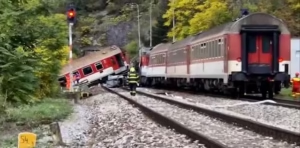
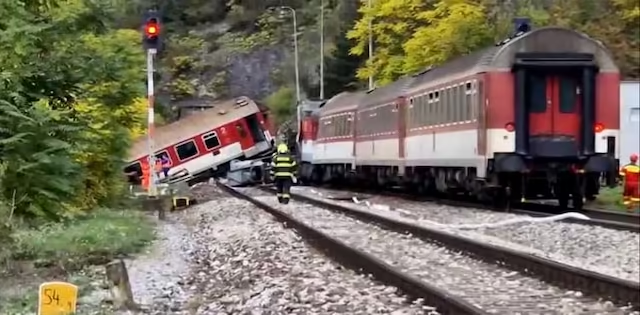
Footage released by the Slovak regional police on Facebook showed a disturbing scene — the front locomotive and one passenger carriage lying partially overturned on a hillside beside the tracks. Twisted metal, shattered glass, and debris were strewn across the grassy embankment. Several rescue workers were seen climbing through damaged doors to reach trapped passengers, while others worked to stabilize the carriages to prevent further movement.
Local residents reported hearing a loud crash followed by screams and the sound of breaking metal. “It was a terrifying noise, like an explosion,” said Martina Horvathova, who lives near the railway line. “When I ran outside, I saw smoke and people trying to climb out of the train windows.”
According to initial findings, the crash happened just after 10:00 a.m. local time (0800 GMT) at a single-track section of the railway — an area where trains usually must wait for clearance before proceeding. The Slovak Railways company (ZSSK) said that early indications point to a signal or communication failure, though investigators have not ruled out human error.
Slovakia train accident Emergency Response and Rescue Efforts
Firefighters, police, and paramedics launched a rapid rescue operation, supported by air ambulance helicopters. Within minutes of the collision, dozens of emergency responders reached the scene to assist survivors. Many passengers were able to escape through broken windows, while others had to be carefully extricated using cutting equipment.
A spokesperson for the Slovak rescue services told AFP that at least 20 people received treatment on-site, while others were taken to nearby hospitals. “Our priority was to stabilize the injured and ensure that no one remained trapped inside the carriages,” the spokesperson said.
Emergency teams established a temporary triage area near the crash site, where medical staff assessed and categorized injuries before transferring victims to regional hospitals. Local volunteers and Red Cross workers distributed water and blankets to shaken passengers awaiting transportation.
Slovakia train accident Authorities Launch Investigation
The Ministry of Transport of Slovakia has ordered a full investigation into the cause of the collision. A special commission comprising officials from the Railway Police, Transport Safety Board, and Slovak Railways (ZSSK) has been formed to examine technical data, black box recordings, and signal records.
Preliminary reports suggest that one of the trains — believed to be a regional passenger service traveling from Kosice to Zvolen — collided head-on with a freight locomotive operating on the same track. Investigators are probing whether a signal malfunction or human error led to both trains being cleared onto the same stretch simultaneously.
Transport Minister Jozef Ráž Jr. visited the site later in the afternoon and praised the quick actions of emergency services. “Thanks to the exceptional response of our rescue teams, we have avoided a far greater tragedy,” he said. “We are now working to determine exactly what went wrong so that such an accident never happens again.”
Slovakia train accident Eyewitness Accounts
Passengers onboard the trains described scenes of chaos and confusion in the moments after the crash. Peter Novak, one of the survivors, told local television that passengers were thrown from their seats as the train suddenly jolted forward. “People were screaming and trying to get out,” he recalled. “The windows shattered, and smoke started coming in. It was terrifying.”
Another passenger, Eva Markova, said that railway staff and other passengers immediately began helping the injured. “Everyone tried to help — we gave first aid to those bleeding, and some people comforted children who were crying. It was shocking but also heartwarming to see everyone come together.”
Regional Impact and Railway Disruptions
The accident caused significant disruption to train services across eastern Slovakia, as authorities temporarily closed the section of track between Roznava and Kosice for safety inspections. Dozens of trains were canceled or rerouted, and bus replacements were arranged for stranded passengers.
Railway engineers worked through the afternoon to remove the derailed carriages and repair the damaged track. Officials from ZSSK said normal operations are expected to resume gradually once the investigation team completes its on-site examination.
Slovakia train accident Safety Record and Broader Context
Slovakia’s railway system, while generally considered safe, has experienced several minor accidents and signal failures in recent years, prompting calls for modernization. Experts note that many of the country’s single-track lines date back decades and require significant infrastructure upgrades to meet modern safety standards.
Railway safety analyst Tomas Miklos said the latest incident should serve as a wake-up call. “This accident shows the urgent need for investment in automatic train control systems and better communication protocols,” he stated. “Even one technical failure on a single-track route can lead to catastrophic consequences.”
The European Union, which has funded multiple railway modernization projects in Slovakia, is expected to monitor the investigation closely. EU transport officials have repeatedly emphasized the need for improved safety systems across Central and Eastern Europe.
Slovakia train accident Government Response and Public Reaction
Prime Minister Robert Fico expressed relief that no lives were lost but pledged a thorough review of railway safety procedures. “We are grateful that this did not become a national tragedy,” he said in a televised address. “However, it highlights the weaknesses in our rail infrastructure that must be urgently addressed.”
Public sentiment across Slovakia has been one of shock and concern. Social media was flooded with messages of support for the injured and praise for the rescuers who responded swiftly. Many Slovaks have also called for greater investment in transport safety to prevent similar incidents in the future.