NOAA official confirmed Dr. Neil Jacobs Confirmed as NOAA Chief Amid “Sharpiegate” Controversy
WASHINGTON — The U.S. Senate on Tuesday confirmed Dr. Neil Jacobs as the new Administrator of the National Oceanic and Atmospheric Administration (NOAA), placing a seasoned atmospheric scientist at the helm of one of the nation’s most critical agencies for weather, oceans, and climate research. Jacobs, who previously served as NOAA’s Assistant Secretary for Environmental Observation, brings extensive experience in atmospheric science, climate monitoring, and advanced weather modeling.
NOAA official confirmed NOAA’s Mission and Significance
NOAA is responsible for safeguarding public safety through accurate weather forecasts, conducting oceanic research, monitoring climate trends, and maintaining long-term environmental datasets. The agency plays a pivotal role in disaster preparedness, hurricane tracking, and climate policy advisory. Its work informs federal, state, and local decision-making and contributes to global scientific collaboration on pressing climate challenges.
Dr. Jacobs’ confirmation comes at a crucial time. With extreme weather events increasing in frequency and severity, NOAA’s ability to provide timely and reliable information has never been more vital. Hurricanes, wildfires, floods, and heatwaves are increasingly testing emergency response systems, and leadership at NOAA directly impacts the nation’s preparedness and resilience.
NOAA official confirmed Neil Jacobs: A Career in Atmospheric Science
Jacobs has spent decades in atmospheric science, focusing on weather prediction, climate modeling, and the integration of advanced technology into environmental observation systems. As NOAA’s Assistant Secretary for Environmental Observation, he oversaw satellite deployments, data acquisition, and improvements in forecasting accuracy. His expertise is widely recognized among peers in the scientific community, and supporters highlight his capacity to modernize NOAA’s operations.
In addition to his technical credentials, Jacobs has been praised for his management skills, particularly his ability to bridge the gap between science, policy, and public communication. Advocates argue that his leadership can help restore trust in NOAA’s mission, especially after politically charged controversies in recent years.
Revisiting “Sharpiegate”
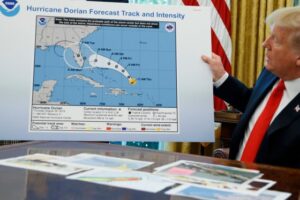
Despite Jacobs’ strong scientific credentials, his appointment has reignited discussions about the 2019 “Sharpiegate” incident, a political controversy that drew national attention. During Hurricane Dorian, then-President Donald Trump falsely claimed that Alabama was at risk from the storm. When the National Weather Service (NWS) office in Birmingham clarified that Alabama was not in danger, Trump displayed a forecast map altered with a black Sharpie to support his claim.
The incident placed NOAA officials in a difficult position. Local forecasters were reprimanded, and questions were raised about political interference in scientific communication. Jacobs, then serving in a senior NOAA role, faced criticism for how he handled the episode. A subsequent review by the National Academy of Public Administration concluded that Jacobs had violated NOAA’s ethics policies, drawing widespread media scrutiny.
At his Senate confirmation hearing in July, Jacobs addressed the controversy candidly, stating, “I would not handle the situation the same way if it were to occur today.” He emphasized the importance of protecting scientific integrity and ensuring that NOAA’s data remains accurate and independent of political influence.
Senate Confirmation and Bipartisan Support
Jacobs’ confirmation passed the Senate after rigorous hearings, reflecting broad recognition of his scientific and administrative expertise. Supporters noted that NOAA requires strong leadership to tackle complex challenges, from improving hurricane prediction models to expanding oceanic research and strengthening climate monitoring systems.
Senators from both parties acknowledged that while past controversies were regrettable, Jacobs’ technical qualifications and leadership vision make him well-suited to guide NOAA in a rapidly changing climate landscape. Advocates argue that his appointment represents a chance to modernize the agency, enhance public trust, and ensure scientific rigor in government decision-making.
Modernizing NOAA and Advancing Climate Science
Under Jacobs’ leadership, NOAA is expected to accelerate several critical initiatives:
-
Improved Forecasting and Disaster Preparedness: By leveraging satellite data, AI-driven models, and advanced computing, NOAA aims to provide faster and more accurate weather predictions, helping communities prepare for extreme events.
-
Climate Monitoring and Research: Jacobs plans to expand NOAA’s research on climate change impacts, including sea-level rise, ocean acidification, and global temperature trends.
-
Data Transparency and Public Trust: Restoring credibility in NOAA’s scientific communications is a priority. Jacobs intends to implement policies that safeguard data from political interference and improve accessibility for the public and policymakers.
-
Technological Innovation: Upgrading observation platforms, satellites, and modeling systems will enhance NOAA’s ability to respond to emerging environmental challenges.
Experts argue that these initiatives will position NOAA to better serve the nation during a period of intensifying climate risks. With increasing frequency of hurricanes, heatwaves, and wildfires, the agency’s ability to deliver reliable forecasts is critical for saving lives and minimizing economic damage.
Challenges Ahead
While Jacobs’ expertise is widely recognized, he inherits significant challenges. NOAA faces political scrutiny, budgetary constraints, and increasing public expectations for timely, accurate forecasts. Climate change has amplified the urgency of NOAA’s mission, and leadership must balance scientific priorities with policy pressures.
Furthermore, the memory of “Sharpiegate” continues to highlight the delicate intersection of science and politics. Jacobs will need to ensure that NOAA maintains independence while navigating a complex landscape of federal oversight and public scrutiny.
Looking Forward
Dr. Neil Jacobs’ confirmation as NOAA Administrator marks a pivotal moment for U.S. weather and climate science. His extensive background in atmospheric science, combined with a commitment to transparency and modernization, positions him to lead the agency into a new era.
As extreme weather events become more frequent and climate challenges intensify, NOAA’s role as a provider of accurate, science-based information is more critical than ever. Jacobs’ leadership will be closely watched by scientists, policymakers, and the public alike, as the agency works to maintain credibility, enhance forecasting capabilities, and strengthen the nation’s resilience to climate risks.
In the wake of past controversies, Jacobs has the opportunity to demonstrate that NOAA can function as an impartial scientific authority, trusted by both policymakers and the public. With his vision and expertise, the agency is set to navigate the complexities of modern environmental science and reaffirm its position as a global leader in climate and weather research.