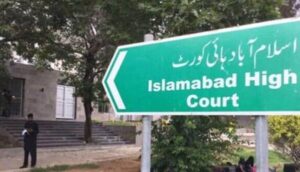
IHC Toshakhana case IHC Hears Acquittal Petitions in Toshakhana Case Against Imran Khan and Bushra Bibi
The Islamabad High Court (IHC) on Thursday resumed hearings in the Toshakhana case, where Pakistan Tehreek-e-Insaf (PTI) founder Imran Khan and his wife Bushra Bibi have filed petitions seeking acquittal from charges related to the alleged misuse of state gifts. The case continues to draw national attention as it involves one of Pakistan’s most high-profile political figures and his spouse, marking another crucial phase in the ongoing legal challenges surrounding the former prime minister.
Court Proceedings and Key Developments
A single-member bench, headed by Justice Inaam Ameen Minhas, took up the case and heard detailed arguments presented by Salman Safdar, the lead counsel representing Imran Khan.
During the hearing, Salman Safdar emphasized that the trial court should be restrained from announcing its verdict in the Toshakhana II case until the Islamabad High Court decides on the acquittal petitions already filed. According to him, proceeding with the trial judgment before the High Court’s decision could lead to overlapping rulings and confusion in the judicial process.
Justice Minhas acknowledged the point and stated that the court would review the matter carefully before making any ruling. The judge clarified that the High Court would first consider the legal merits of the petitions before determining whether to intervene in the lower court’s proceedings.
Background of the Toshakhana Case
The Toshakhana — a government department established in 1974 — is responsible for keeping records of gifts received by state officials from foreign dignitaries. According to Pakistani law, any public officeholder who receives a gift must declare it and, if they wish to retain it, pay a certain portion of its value to the national treasury.
In the case of Imran Khan, the Election Commission of Pakistan (ECP) alleged that he failed to disclose several valuable gifts received during his tenure as prime minister. These included luxury watches, jewellery sets, and other expensive items.
Following these allegations, multiple Toshakhana-related cases were filed, with Toshakhana I leading to Imran Khan’s conviction earlier in 2023. However, the IHC Division Bench later suspended that sentence, allowing Khan temporary relief pending further appeals.
Now, the Toshakhana II trial — a continuation of the same controversy — has reached its final stages in the trial court.
Arguments Presented by the Defense
Advocate Salman Safdar informed the IHC that the Toshakhana II trial concerns similar allegations that have already been adjudicated in the earlier case. He argued that proceeding with multiple cases on the same subject constitutes double jeopardy, which is prohibited under Pakistani and international law.
Safdar further pointed out that the trial court is rushing to announce its decision without waiting for the IHC’s ruling on the acquittal petition. According to him, this approach is unjustified and could cause legal complications later.
He stated,
“The High Court has already suspended the sentence in the earlier Toshakhana case. Until this bench decides on the acquittal petition, the lower court should not proceed to judgment.”
The defense lawyer emphasized that Imran Khan has fully cooperated with all ongoing investigations and has disclosed his assets transparently in past election documents.
Specific Allegations in the Case
When the bench inquired about the exact nature of the charges, Safdar explained that Imran Khan and Bushra Bibi are accused of retaining and selling state gifts that were received during Khan’s tenure as the Prime Minister of Pakistan.
These gifts allegedly include a valuable jewellery set and other luxury items that, according to the prosecution, were not properly disclosed in the official records submitted to the Election Commission of Pakistan (ECP).
However, the defense maintains that the gifts were legally purchased by paying the required amount to the Toshakhana, and that the entire process was conducted under government rules.
Court’s Observations and Next Steps
Justice Inaam Ameen Minhas took note of the arguments and confirmed that notices have been issued to all relevant parties. The court will now review their responses before making any final decision regarding the acquittal pleas.
The judge also mentioned that the High Court intends to avoid conflicting decisions between the IHC and the lower courts. He assured both sides that the case would be decided based on the facts presented and the applicable laws.
The court then adjourned the hearing, stating that it would resume proceedings once the responses are received from the prosecution and other stakeholders.
Legal Context and Broader Implications
The Toshakhana controversy has not only become a legal issue but also a major political flashpoint in Pakistan. The outcome of this case could have significant implications for Imran Khan’s political future, especially considering his ongoing disqualification cases and party leadership challenges.
Legal analysts suggest that the High Court’s handling of this case could set an important precedent for how accountability laws are applied to public officeholders in Pakistan. If the court finds procedural flaws or overreach by the trial court, it could lead to major relief for the former premier and his wife.
Meanwhile, government sources insist that the case represents an important step toward upholding transparency and rule of law, arguing that all citizens — regardless of political status — must be held accountable for their actions.
Political Reactions
The PTI has welcomed the IHC’s decision to hear the acquittal petitions and has expressed confidence that Imran Khan will be cleared of all charges. Party officials argue that the Toshakhana case is politically motivated, claiming that similar actions by previous leaders were never scrutinized this aggressively.
Opposition parties, on the other hand, maintain that the law should take its course and that public officials must be held accountable for any misuse of authority.
Conclusion
The Islamabad High Court’s ongoing hearing in the Toshakhana case marks another critical moment in Pakistan’s complex political and legal landscape. With both Imran Khan and Bushra Bibi seeking acquittal, and the trial court nearing its judgment, all eyes are now on the IHC’s next move.
The court’s decision will not only determine the fate of one of Pakistan’s most influential political figures but also influence how future cases of asset disclosure and public accountability are handled in the country.
Until then, the case remains one of the most closely watched legal battles in recent memory, symbolizing the tense intersection of politics, law, and public trust in Pakistan’s evolving democracy.